 by Angela Reed-Fox What do you do when a rider's late to indoor cycling class?No doubt you'll have come across this situation before if your venue doesn't have a policy on late class entries. We've found the following works well as a 7 step process:
1. Pre-educate your riders Even before the situation next presents, you can prepare your riders. Educate them - let them know the reasons for warming up, what it does, the benefits to them, and also (this will tend to stick in riders' minds for longer) what they stand to lose by skipping it. If they realise there are real physiological reasons, they're more likely to take the warm-up - and you - seriously. Remind your riders why they're warming up - for example getting into the right mindset, warming and preparing muscle tissue, cardiovascular system and lubricating joints, reducing risk of injury. Remind them that with a proper warm up they'll be able to better tackle the challenges you have planned for them, that by warming up they'll be prepared and better able to work harder (and get better results). Remind them that you've lovingly prepared the session's profile and that you don't want them to miss a second of the delights you have in store. Teaching your riders about the importance of a warmup also presents you as an expert they can trust and respect. Trust and respect are great in the long-term as you decrease incidences of lateness to your classes - but also ddevelop more of a following as riders recognise that you know what you're talking about! You can ask them who gets the importance of a good warmup. Ask for a response. There's psychology behind this - humans are very consistent creatures. If they say they agree with something, or stand for something, they're very likely to follow this through with action. Just by allowing your riders to voice their appreciation of how important a warm-up is will help to reduce lateness, you can trust that they are more likely to act in line with what they say than go against it. 2. Keep it light - and check for injuries Riders are there to have a good time as well as an effective workout. The great thing is they came! The less great thing is they're late. Be warm and encouraging. You're most likely going to be on the bike already when your late rider turns up. From the bike (so that you have witnesses) ask them if they have any injuries - and then pop off your bike, and go over to them, once you've given your other riders something to carry on with (either the next step of their warm up or their first challenge). 3. Check again Once you're in front of the rider, park the microphone so you can talk solely to your latecomer. Check again that they have no injuries or other matters that you should be aware of. If you're both satisfied that your latecomer is fit to ride they will need to do a proper warm up. Give them at least 10 minutes of pedalling before you draw them into the rest of the class. You may need to reinforce why the warm up is important. 4. Don't skimp on the warm-up Your venue may have a 10 minute rule whereby any rider arriving more than ten minutes (or other time period) may not be permitted. Different venues have different policies - this article is concerned with how you, the instructor, can respond within the confines of venue policy. Regardless of when the rider arrives, they need to complete a full warm up. Not only does this have the obvious physiological benefits to safely prepare them for the rest of the workout, but also it emphasises that you take your class seriously, just as you take your riders' health seriously. If you skip the warm up for latecomers, it's almost a tacit encouragement for others to arrive at their own convenience, as well as portraying the warm-up as a formality that can be casually skipped. 5. Get the party started If you haven't already, get the rest of the class started on the body of the workout. Keep an eye on your latecomer, and bring them in when they're suitably warm. If you don't have heartrate training and therefore can't see where they're at, use RPE to let them know where they should be after how long. Once they've reached the required level after the required amount of time (don't rush it!) you can join them in to what the rest of the class is doing. 6. Be nice Always always be nice. Remember that you're there as a coach and to give your riders a great and effective experience. Riders will respect you more as an instructor if they see that you are consistent, that you care about your welfare, and that you run a great, organised class. We've not encountered any problems from riders when we follow this plan. It's light-handed, it's professional, and riders know where they are and what's expected.
0 Comments
 by Angela Reed-Fox Indoor Cycling Instructor tips - fixed wheelWhat? The way the stationary bike works is by a fixed wheel, which essentially means that when the pedals are turning so does the flywheel. Conversely, if the flywheel is turning, so will the pedals. And this right here is the crux of why it's important that instructors understand the implications, but also that they tell riders what they need to know in order to stay safe. There are several instances every year of cycling studios and their instructors being sued because of injuries occurring during an indoor cycling session. We've had a look through what the causes are - and I'd say over 95% of them were completely avoidable and due to either a lack of knowledge on the instructor's part, or poor instructing (twp reasons why the Indoor Cycling Institute exists). And the rest? Really weird stuff that happens when you store hand-held weights on the back of the bike or dark studios where people can't see what's going on, that type of thing. What you need to tell your riders
What you need to concentrate on during your class Warming up
The warming up pace should be leisurely, but riders should be in control of the pedals and feel the bike's resistance as they go. At all times,coach riders with how the resistance should feel (especially if the bikes have no metrics). Sprinting Most injuries (and litigation) occur as a result of a rider sprinting incorrectly. Make sure you coch correct resistance, technique and cadence. Click here for more about sprinting. Climbing 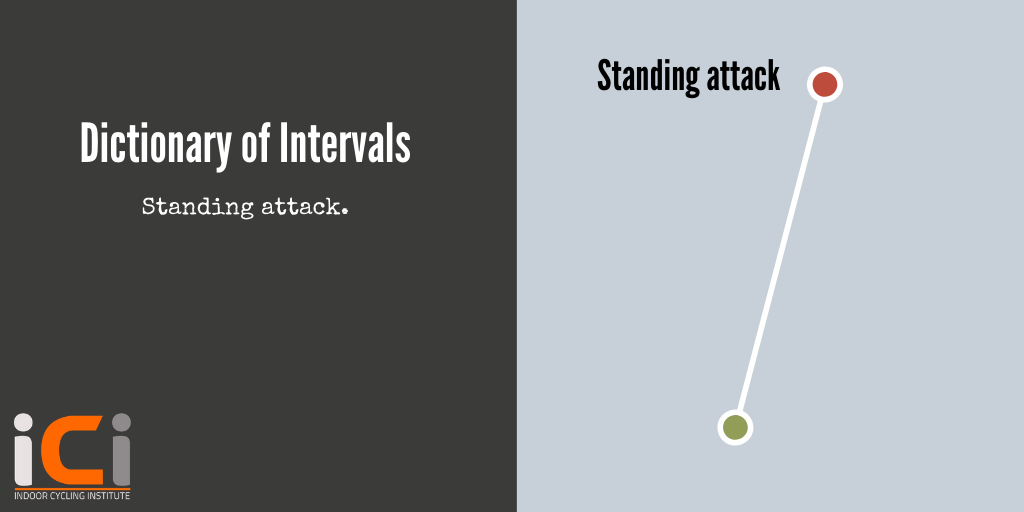 Indoor Cycling Instructor Dictionary of Intervals: Standing AttackPosition or interval: The standing attack is a position.
What it is: A maximal intensity interval out of the saddle. Cadence: The cadence is usually between 75-85rpm. Intensity: The standing attack is maximal intensity. Length: Because the standing attack requires the CP energy system, this intense effort can only be sustained for several seconds - 10-15 seconds is perfect. When to use: only when riders are properly warmed up - and best in the second half of the session. Use it in sets of 3-6. What it does: Trains the CP system and builds power. Key teaching points:
|





Professional standardsIndoor Cycling Instructor Scope of Practice
ICI Code of Professional Conduct ICI Safety Standards for Indoor Cycling Sessions ICI Cadence and Intensity Guidance ICI New Rider Onboarding Standard ICI Guidance for Studios and Operators ICI Incident and Near-Miss Reporting Guidance ICI Studio and Management Guidance What Riders Should Expect from an Indoor Cycling Instructor Position statementsIndoor Cycling as a Specialist Discipline
Teaching Intensity in Indoor Cycling Cadence, Resistance and Rider Control Purpose-Led Session Design Use of Music in Indoor Cycling Sessions Choreography and Non-Cycling Movements New Rider Safety Virtual and On-Demand Indoor Cycling Sessions Professional Standards, Certification and Recognition Experience, Reflection and Ongoing Development |


|
|
Further learning
|
More
|

|
The Indoor Cycling Institute supports education, guidance and good practice in indoor cycling.
Train | Develop | Belong
Train | Develop | Belong
© 2014-2026 Protheorem Ltd